
Did you know that CARTA maintains an Anthropogeny Publications Exchange (APE), a resource for anthropogeny-related publications informing on human evolution, origins, and uniqueness? We created an AI summary of the publications we’ve added to APE between January 1 and July 15, 2026, broken into broad topics.
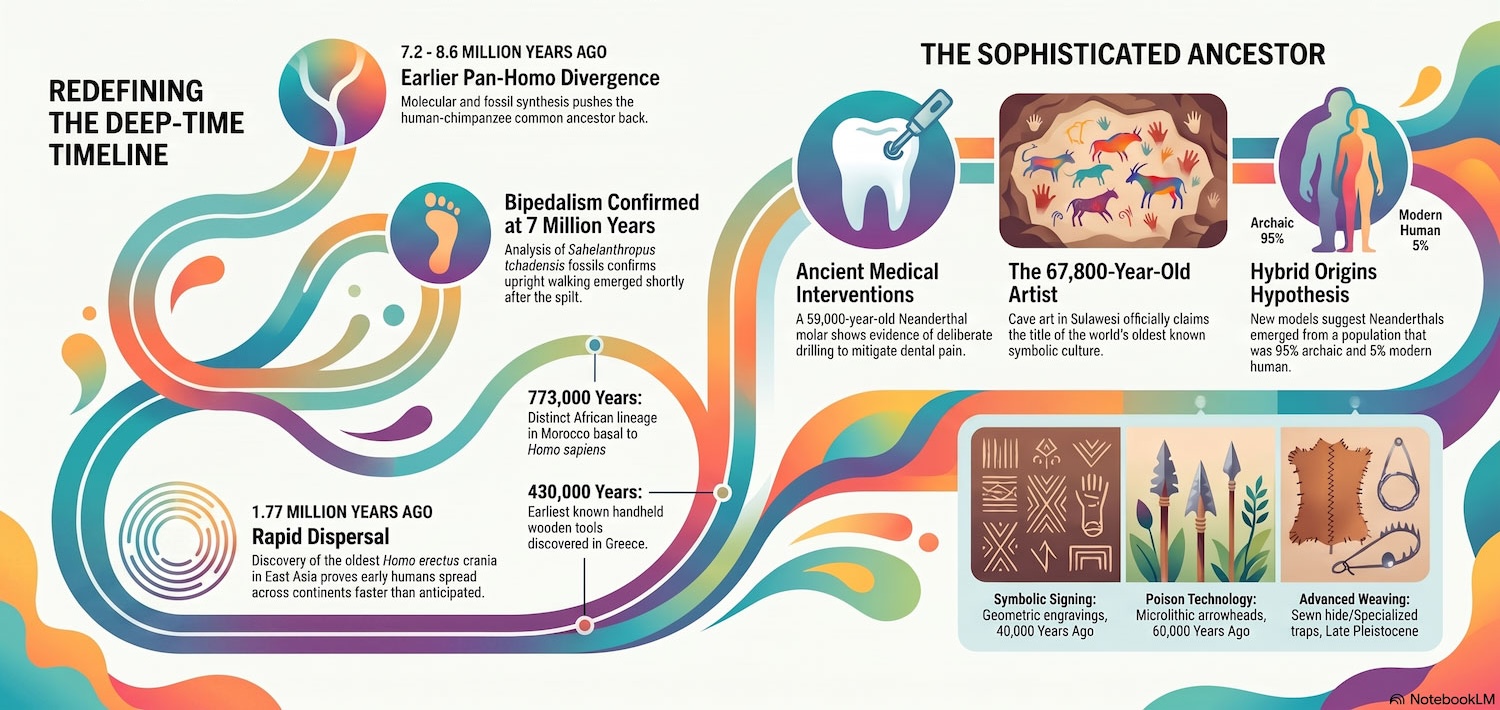
The Anthropogeny research published in 2026 has been characterized by a massive influx of high-resolution genomic data, refined chronologies, and a shift toward computational models. Researchers are increasingly moving away from simple linear models of evolution, instead identifying “mosaic” patterns of development, deeper cultural roots for symbolic behavior, and a more complex picture of our ancestors’ interactions with archaic hominins.
New Insights into Human Evolution
These studies refine the deep-time timeline of hominin history, pushing back the origins of bipedalism and re-evaluating the physical and cognitive characteristics of our early ancestors.
- Earliest evidence of hominin bipedalism in Sahelanthropus tchadensis: Limb fossil analysis at 7 million years ago confirms early adaptations for upright walking shortly after our split from the chimpanzee lineage.
- Parting ways: Pan-Homo divergence revisited: Synthesis of molecular and fossil data pushes the human-chimpanzee common ancestor back to 7.2–8.6 million years ago.
- Early hominins from Morocco basal to the Homo sapiens lineage: A 773,000-year-old discovery in Morocco highlights a distinct African evolutionary lineage long before the emergence of modern humans.
- Evolutionary drivers of encephalization and facial reduction in the genus Homo: Suggests that brain growth was governed more by environmental constraints and neutrality than by a constant, linear selective pressure for intelligence.
Neanderthals and Other Archaic Interactions
Recent genomic and archaeological findings have dismantled the image of Neanderthals as primitive, revealing them to be cognitively sophisticated, culturally complex, and interconnected with some modern human populations.
- PREPRINT - Hypothesis: A modern human range expansion ~300,000 years ago explains Neandertal origins: A bold model suggesting Neanderthals emerged from a hybrid population that was 95% archaic in ancestry.
- Interbreeding between Neanderthals and modern humans was strongly sex biased: Genetic evidence indicates a persistent mating preference for Neanderthal males and modern human females.
- Earliest evidence for invasive mitigation of dental caries by Neanderthals: A 59,000-year-old tooth shows evidence of deliberate drilling, pushing back the timeline for complex medical intervention.
- Genetic diversity of late Neanderthals in northwestern Europe: High-resolution DNA analysis reveals that late-stage populations were robust and interconnected rather than suffering from genetic decline before extinction.
The Ancient Roots of Culture and Cognition
This cluster challenges the notion that complex “behavioral modernity” emerged suddenly, presenting evidence for ancient symbolic, artistic, and social capacities.
- Rock art from at least 67,800 years ago in Sulawesi: The oldest-dated cave art globally, pushing the timeline of maritime-migrating modern humans’ artistic culture back significantly.
- Humans 40,000 y ago developed a system of conventional signs: Statistical analysis of engravings reveals systematic, information-dense geometric sequences that could have functioned as a proto-writing system.
- Lower Palaeolithic Tools of Potency: Discoveries of handaxes crafted specifically around fossils and crystals suggest early humans viewed tools as spiritual or aesthetic objects.
Primatology and the Biology of Sociality
By comparing human development and behavior with our closest living relatives, these studies provide a biological basis for our social structures, communication, and cognitive evolution.
- Chimpanzee locomotor risk-taking points to the importance of parental and alloparental supervision in humans: Suggests human teenage risk-taking is a result of relaxed oversight rather than an inherent biological quirk.
- Lethal conflict after group fission in wild chimpanzees: Demonstrates that organized, lethal violence can emerge from simple social friction, challenging the idea that warfare is purely a cultural invention.
- The evolution of human infants’ helplessness: Frames infant dependency not as a disadvantage, but as a relational developmental system that drives human social and cognitive resilience.
- Comparative primate analysis shows that humans are not unique in having a tight cephalopelvic fit at birth: Reveals that birth constraints are a common feature of small-pelvis/large-head primate species.
The “New” Archaeology: Materials and Environments
These papers demonstrate how cutting-edge technical tools—from 3D computational morphometrics to paleoproteomics—are refining our interpretation of prehistoric sites.
- Getting into shape: computing continua of Middle Stone Age prepared core technology: Introduces 3D scanning to prove that stone tool styles form fluid spectra rather than rigid, categorized boxes.
- The oldest in situ Homo erectus crania in eastern Asia: The Yunxian site dates to ~1.77 Ma: Resolves a major chronological puzzle, showing rapid dispersal of early humans across Asia.
- Enamel nanocrystal misorientation increased with meat-eating and agriculture: Provides a nanoscale biological record of how human diets have physically reshaped our dentition.
- Investigating ancient human DNA preservation on cave walls and in rock art: Successfully extracts genetic material from cave environments without the need for skeletal remains, opening new possibilities for non-invasive archaeology.

