
Specialization Track
Aims and Objectives
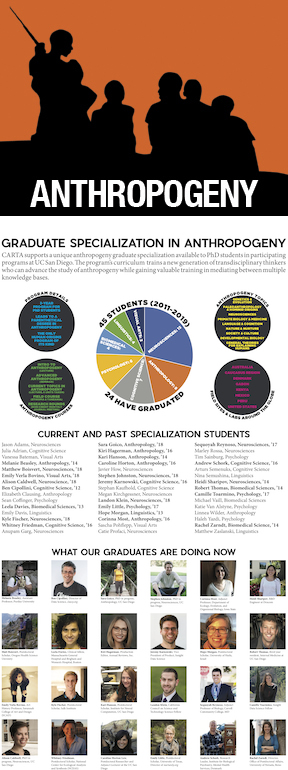
Click to see 10th Anniversary Summary
The "Faculty of Anthropogeny," which includes CARTA members and local experts, offers a transdisciplinary Graduate Specialization in Anthropogeny. It provides graduate students from within a variety of participating UCSD PhD programs the opportunity to obtain a parenthetical degree in research and education on explaining the human phenomenon. The goal is to provide a broad and explicitly transdisciplinary approach spanning the social and natural sciences by focusing on one of the oldest questions of humankind, namely, the origins of humans and humanity.
The broad topic areas include:
- Human and Primate Genetics and Evolution
- Paleoanthropology and Hominid Origins
- Mammalian and Primate Neurosciences
- Primate Biology and Medicine
- Language and Cognition
- Nature-Nurture Interactions in Explaining Language and Cognition
- Human and Primate Society and Culture
- Comparative Developmental Biology of Primates
- General Theories for Explaining Humans
Participating PhD-Granting Programs for a Specialized Track in Anthropogeny
- Anthropology
- Biomedical Sciences
- Biological Sciences
- Cognitive Science
- Linguistics
- Neurosciences
- Psychology
- Rady School of Management
- Visual Arts
Requirements and Courses
Students participating in the Graduate Specialization in Anthropogeny are required to take the following courses:
- Introduction to Anthropogeny ANTH 203 (4 credits): a graduate elective course open to PhD students from participating programs at UCSD, space allowing. 10 lectures/discussion sessions.
- Advanced Anthropogeny BIOM 229 (2 credits): a graduate course open only to PhD students from participating programs at UCSD and enrolled in the specialization. Pre-requisite: Introduction to Anthropogeny. 10 lectures/discussion sessions.
- Current Topics in Anthropogeny (BIOM218): a graduate elective course open to PhD students from participating programs at UCSD, space allowing and instructor approval required. Specialization students are required to participate in 6 CARTA symposia.
It is highly recommended that specialization students also participate in the following optional meetings and course:
- Anthropogeny Research Rounds: a monthly meeting where students and faculty discuss their respective research along with relevant human origins research. Non-specialization students are encouraged to attend these meetings as well.
- Anthropogeny Field Course in Tanzania (ANTH289S): open only to PhD students from participating programs at UCSD in their second or third year of enrollment in the specialization, this optional course is held over three weeks in Tanzania during the summer quarter. Students experience field research, the ecological context of human adaptation, and the three major approaches to studying the origins of our species (fossil evidence, comparative biology, and ethnography of human foragers). Contact Dr. Pascal Gagneux for more details.
Dr. Pascal Gagneux talks about CARTA's field course
Enrolling in the Graduate Specialization in Anthropogeny
Students enrolled in the Graduate Specialization in Anthropogeny must commit to fulfilling all requirements of the program. Due to considerable time and financial investment by the Faculty of Anthropogeny, along with limited enrollment space, only exceptional personal circumstances will relieve students of this commitment.
Ph.D. students in any of the participating programs at UCSD who have advanced to candidacy may enroll in the specialization track. If interested in participating, please email Dr. Pascal Gagneux. Once approved, students must work with their "home" department graduate coordinator to change their major code in Student Database. If the major code does not currently exist, then the coordinator must complete a general petition to add their major codes to the Anthropogeny specialization. Coordinators can contact the Assistant Dean of Graduate Academic Affairs in GEPA for guidance.
Fellowships
CARTA’s Anthropogeny Graduate Fellowship Program offers competitive awards to Ph.D. students enrolled in, and actively participating in, the Anthropogeny Graduate Specialization at UC San Diego (eligibility requirements must be met in order to qualify). Anthropogeny Graduate Fellowships allow students to devote more time to completing the three-year Specialization program and their own Ph.D. program’s requirements and less time on seeking other funding sources.
Transdisciplinary Graduate Training Program in Anthropogeny
While Anthropology is the discipline that comes closest, the Graduate Specialization in Anthropogeny offered at UCSD is, at present, the only graduate program anywhere specifically dedicated towards a transdisciplinary education in human origins.
- Demands While existing scientific disciplines continue to expand their respective bodies of knowledge, making it impossible for any individual to keep up with all the progress even in narrowly defined research areas, the capacity to understand and integrate scientific findings from widely differing fields of research will become an increasingly important, yet rare, skill. The study of human origins is a key example of a research endeavor which critically relies on such integration skills. The Graduate Specialization in Anthropogeny aims to equip future scientists with the necessary interdisciplinary skills and panoramic perspective needed for advancing our understanding of human origins.
- Market Needs Areas as disparate as medicine, public health, environmental policy and marketing have come to increasingly rely on evolutionary approaches to observed human phenomena. Public and private sectors alike have an increasing need for individuals with scientific training accompanied by understanding of natural and social sciences and the capacity to translate findings from these different areas for specialists and the public at large.
- Placement Opportunities Graduate students who complete the program requirements will complement their traditional degree with a parenthetical degree in Anthropogeny. In doing so, they will also gain valuable training in transdisciplinary research spanning the social and natural sciences. Such skill and qualification will greatly benefit students as they embark on future careers in both public and private sectors, where the capacity to mediate between different types of knowledge bases is becoming increasingly important. Whether their future careers are in teaching, basic research, industry, public service or private enterprise, their capacity for working with findings from a variety of disciplines is bound to make them valuable assets for their employers.
Contact
| Attachment | Size |
|---|---|
 Anthropogeny_Program_Guide_7.1.2016.pdf Anthropogeny_Program_Guide_7.1.2016.pdf | 497.2 KB |

