
The Mismeasure of Man
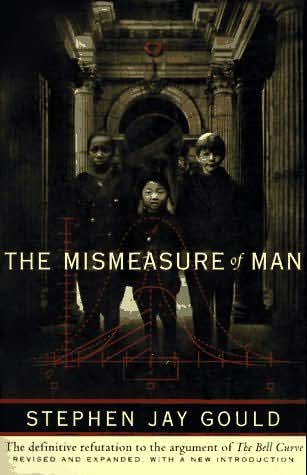
When published in 1981, "The Mismeasure of Man" was immediately hailed as a masterwork, the answer to those who would classify people, rank them according to their supposed genetic gifts and limits. And yet the idea of innate limits—of biology as destiny—dies hard, as witness the attention devoted to "The Bell Curve," whose arguments are here so effectively anticipated and thoroughly undermined by Stephen Jay Gould. In this edition Dr. Gould traces the subsequent history of the controversy on innateness right through "The Bell Curve." Further, he has added five essays on questions of "The Bell Curve" in particular and on race, racism, and biological determinism in general. "A major contribution toward deflating pseudobiological 'explanations' of our present social woes."Introduction to the revised and expanded edition : thoughts at age fifteen -- The fram of The Mismeasure of man -- Why revise The Mismeasure of man after fifteen years? -- Reasons, history and revision of The Mismeasure of man -- I. Introduction -- 2. American polygeny and craniometry before Darwin : Blacks and Indians as separate, inferior species -- A shared context of culture -- Preevolutionary styles of scientific racism : monogenism and polygenism -- Louis Agassiz, America's theorist of polygeny -- Samuel George Morton, empiricist of polygeny -- The case of Indian inferiority : Crania Americana -- The case of the Egyptian catacombs : Crania Aegyptiaca -- The case of the shifting Black mean -- The final tabulation of 1849 -- Conclusions -- The American school and slavery -- 3. Measuring heads : Paul Broca and the heyday of craniology -- The allure of numbers -- Introduction -- Francis Galton, apostle of quantification -- A curtain-raiser with a moral : numbers do not guarantee truth -- Masters of cranimoetry : Paul Broca and his school -- The great circle route -- Selecting characters -- Averting anomalies -- Big-brained Germans -- Small-brained men of eminence -- Large-brained criminals -- Flaws in a pattern of increase through time -- Front and back -- The cranial index -- The case of the foramen magnum -- Women's brains -- Postscript -- 4. Measuring bodies : two case studies on the apishness of undesirables -- The ape in all of us : recapitulation -- The ape in some of us : criminal anthropology -- Atavism and criminality -- Animals and savages as born criminals -- The stigmata : anatomical, physiological, and social -- Lombroso's retreat -- The influence of criminal anthropology -- Coda -- Epilogue5. The hereditarian theory of IQ : an American invention -- Alfred Binet and the original purposes of the Binet scale -- Binet flirts with craniometry -- Binet's scale and the birth of IQ -- The dismantling of Binet's intentions in America -- H.H. Goddard and the menace of the feeble-minded -- Intelligence as a Mendelian gene -- Goddard identifies the moron -- A unilinear scale of intelligence -- Breaking the scale into Mendelian compartments -- The proper care and feeding (but not breeding) of morons -- Preventing the immigration and propagation of morons -- Goddard recants -- Lewis M. Terman and the mass marketing of innate IQ -- Mass testing and the Stanford-Binet -- Terman's technocracy of innateness -- Fossil IQ's of past geniuses -- Terman on group differences -- Terman recants -- R.M. Yerkes and the army mental tests : IQ comes of age -- Psychology's great leap forward -- Results of the army tests -- A critique of the army mental tests -- The content of the tests -- Inadequate conditions -- Dubious and perverse proceedings : a personal testimony -- Finagling the summary statistics : the problem of zero values -- Finagling the summary statistics : getting around obvious correlations with environment -- Political impact of the army data -- Can democracy survive an average mental age of thirteen?

