Ever wonder why our closest living relatives, chimpanzees, sleep in nests high above the ground and we don’t? Author Robert Moor set out to answer that very question, traveling from his home in Halfmoon Bay, British Columbia, to the Greater Mahale Ecosystem Research and Conservation area (GMERC) in western Tanzania in 2022.
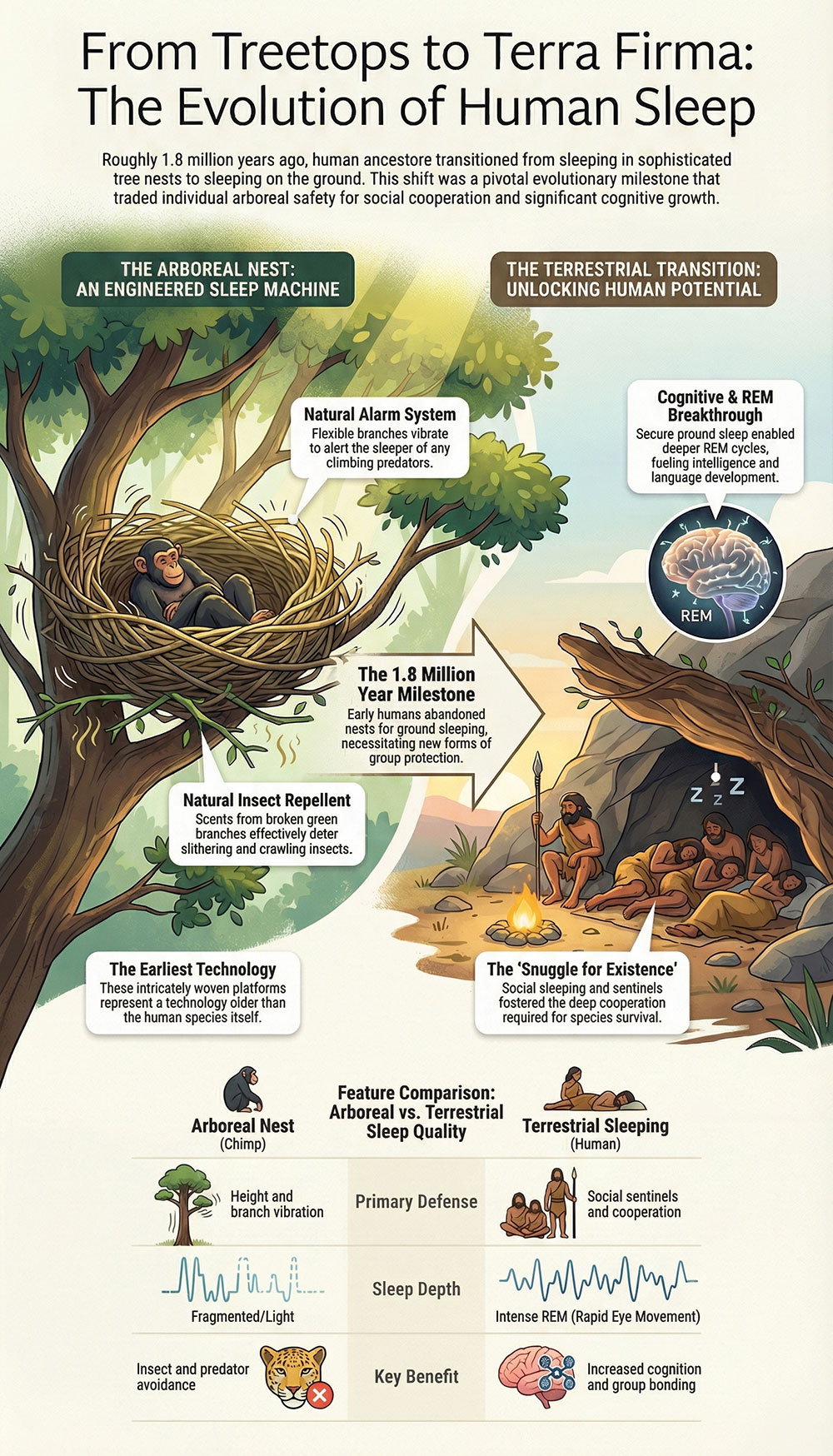
He was drawn to the remote research station because GMERC principal investigator, primatologist, and CARTA member Fiona Stewart had spent years studying chimpanzee nesting behavior and could offer both expert insight and abandoned chimpanzee nests for him to sleep in himself. Moor was compelled to give nest-sleeping a try because of Stewart’s own immersive research methods. To better understand the sleeping habits of chimpanzees, Stewart had spent many nights sleeping both in chimpanzee nests and on the forest floor, effectively transforming her own body into a scientific instrument. Her findings were clear and compelling: elevated nests dramatically reduced sleep disturbances and insect and predator exposure compared to being on the ground.
For Moor, these findings raised an even bigger question: if nest-sleeping provided so many advantages, why did the human lineage transition to ground-sleeping? Researchers believe the shift to ground-sleeping may have fostered greater social cooperation and improved REM sleep cycles, factors that may also have contributed to the evolution of enhanced human cognitive abilities (see the infographic below for more information).
Coincidentally, CARTA Executive Co-Director Pascal Gagneux was visiting GMERC during Moor’s stay and shared stories of his own chimpanzee nest experiences. Gagneux’s fieldwork in the Taï Forest, Côte d’Ivoire, involved climbing trees to collect DNA samples from more than 300 chimpanzee nests.
You can read Moor’s firsthand account of his nest-sleeping experiment, along with further exploration of the evolution of human sleep, in his April 7, 2026 National Geographic article, My sleepless night in a chimpanzee nest, and in his new book, In Trees (Simon & Schuster, 2026).