
Who Needs Emotions? The Brain Meets the Robot
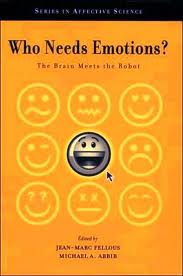
The idea that some day robots may have emotions has captured the imagination of many and has been dramatized by robots and androids in such famous movies as 2001 Space Odyssey's HAL or Star Trek's Data. By contrast, the editors of this book have assembled a panel of experts in neuroscience and artificial intelligence who have dared to tackle the issue of whether robots can have emotions from a purely scientific point of view. The study of the brain now usefully informs study of the social, communicative, adaptive, regulatory, and experimental aspects of emotion and offers support for the idea that we exploit our own psychological responses in order to feel others' emotions. The contributors show the many ways in which the brain can be analyzed to shed light on emotions. Fear, reward, and punishment provide structuring concepts for a number of investigations. Neurochemistry reveals the ways in which different "neuromodulators" such as serotonin, dopamine, and opioids can affect the emotional valence of the brain. And studies of different regions such as the amygdala and orbitofrontal cortex provide a view of the brain as a network of interacting subsystems. Related studies in artificial intelligence and robotics are discussed and new multi-level architectures are proposed that make it possible for emotions to be implemented. It is now an accepted task in robotics to build robots that perceive human expressions of emotion and can "express" simulated emotions to ease interactions with humans. Looking towards future innovations, some scientists posit roles for emotion with our fellow humans. All of these issues are covered in this timely and stimulating book which is written for researchers and graduated students in neuroscience, cognitive science, psychology, robotics, and artificial intelligence."Edison" and "Russell": definitions versus inventions in the analysis of emotion / Jean-Marc Fellous and Michael A. Arbib -- Could a robot have emotions? Theoretical perspectives from social cognitive neuroscience / Ralph Adolphs -- Neurochemical networds encoding emotion and motivation: an evolutionary perspective / Ann E. Kelley -- Toward basic principles for emotional processing: what the fearful brain tells the robot / Jean-Marc Fellous and Joseph E. Ledoux -- What are emotions, why do we have emotions, and what is their computational basis in the brain? / Edmund T. Rolls -- How do we decipher others' minds? / Marc Jeannerod -- Affect and proto-affect in effective functioning / Andrew Ortony, Donald A. Norman, and William Revelle -- The architectural basis of affective states and processes / Aaron Sloman, Ron Chrisley, and Matthias Scheutz -- Moving up the food chain: motivation and emotion in behavior-based robots / Ronald C. Arkin -- Robot emotion: a functional perspective / Cynthia Breazeal and Rodney Brooks -- The role of emotions in multiagent teamwork / Ranjit Nair, Milind Tambe, and Stacy Marsella

