
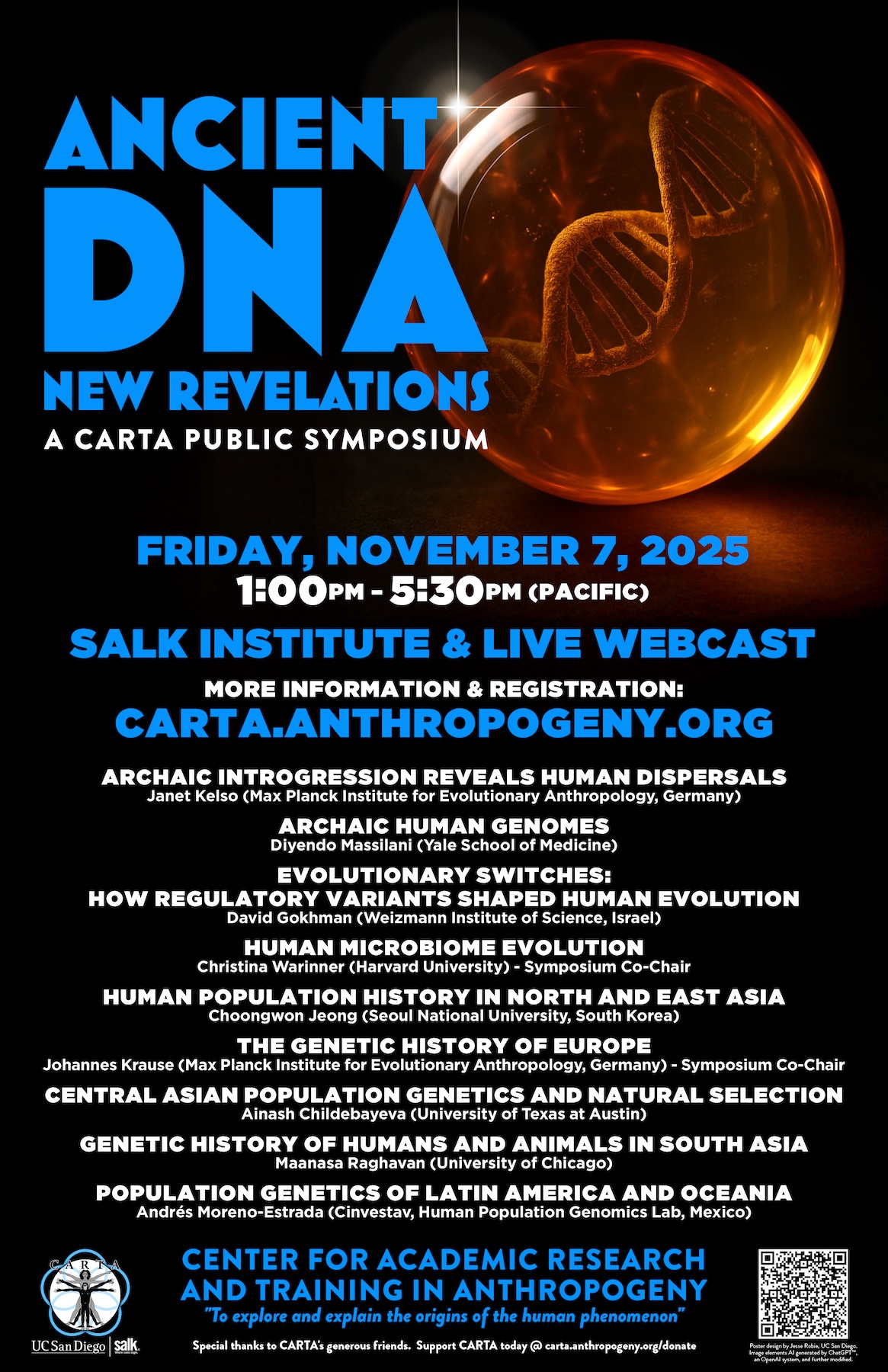
Ancient DNA: New Revelations
Christina Warinner, Harvard University
Johannes Krause, Max Planck Institute for Evolutionary Anthropology
Talks were recorded and will be posted on this page in the weeks following the event. Follow this event page, as well as CARTA’s social media accounts (see page footer), for updates.
Summary:
Dramatic advances in ancient DNA technologies have revolutionized our understanding of the human past. Since the publication of the first ancient human genomes in 2010, the field of archaeogenomics has grown at an astonishing pace, and today the genomes of more than 10,000 ancient humans have been sequenced. From discovering surprising new members of the human lineage to revealing the unexpected histories of infectious diseases to tracking the great migrations that laid the foundations of present-day societies, ancient DNA is rewriting the human story. This symposium explores the diverse applications of archaeogenomics in shaping not only a new vision of the human past, but also in creating a greater understanding of the present and our shared human future. This symposium is an update to our April 2016 event, Ancient DNA and Human Evolution.
Media for each talk can be played by clicking on icons in the table below, or by clicking on the individual talk titles below and then the attachment file at the bottom of the page.
| Speakers | Media | Session |
|---|---|---|
 Gerald Joyce  Johannes Krause |
 |
Welcome & Opening Remarks Welcome by CARTA Co-Director and Salk Institute President, Jerry Joyce. Opening remarks by Event Co-chair, Johannes Krause. |
 Janet Kelso |
|
Archaic introgression reveals human dispersals The genome sequences of Neandertals and Denisovans have provided a wealth of new information about the origins, migrations, and interactions of ancient humans. These genomes have revealed that mixture between hominin groups was common: all modern humans outside Africa carry around 2% Neandertal DNA from a single major episode of Neandertal gene flow, while the ancestors of present-day Asians and Oceanians also met and mixed with multiple, genetically distinct Denisovan populations.... read more |
 Diyendo Massilani |
|
Archaic human genomes The sequencing of genomes from archaic humans, such as Neanderthals and Denisovans, has transformed our understanding of human evolutionary history. These ancient genomes reveal that modern humans did not evolve in isolation but interbred with now-extinct groups, leaving lasting genetic legacies. To date, genomic sequences from 31 archaic human individuals, including four sequenced to high coverage, have provided unprecedented insights into the population structure, social organization, and... read more |
 David Gokhman |
|
Evolutionary switches: How regulatory variants shaped human evolution Changes in gene regulation are key drivers of human evolution. However, how and which regulatory changes shaped human adaptations remains largely unknown. Here, we employed massively parallel reporter assays (MPRAs) in skeletal and neural cells to uncover the function of the 71,443 variants distinguishing Neanderthals and Denisovans from modern humans. This extensive catalog allowed us to discover hundreds of variants that altered human expression, providing the first insight into the function... read more |
 Christina Warinner |
|
Human microbiome evolution Humans have a deep and complex relationship with microbes. Beyond disease, microbes also profoundly shape human health and behavior through their activity in the microbiome and their diverse roles in food and cuisine. And yet we know very little about the origin, evolution, or ecology of the trillions of microorganisms that call us home. Recent advances in genomic and proteomic technologies are opening up dramatic new opportunities to investigate the complex and diverse microbial communities... read more |
 Choongwon Jeong |
|
Human population history in North and East Asia The Kazakh and Mongolian Steppes span ~5,000 km west to east along the northern latitude of Asia. This unique ecozone allowed rapid movements of people, animals, goods, and ideas across Eurasia since prehistory and harbored numerous polities of pastoralists that made tremendous impacts on human history. However, the region’s dynamic genetic history has been emerging only recently from archaeogenomic studies. Here, I will overview our current understanding of the region’s genetic history... read more |
|
Johannes Krause |
|
The genetic history of Europe: From the first settlement of Europe to the medieval migration period Ancient DNA offers insights into prehistoric events that are invisible through archaeology or modern genetics alone. Over the past decade, archaeogenetics has analyzed more than 15,000 ancient genomes spanning 45,000 years of western Eurasian prehistory, uncovering dozens of migrations that reshaped Europe. This lecture will trace the earliest, unsuccessful attempts of modern humans to settle Europe after leaving Africa around 50,000 years ago, when they also interbred with Neandertals. We... read more |
 Ainash Childebayeva |
|
Central Asian population genetics and natural selection Ancient DNA has revolutionized the study of the human past, providing unprecedented insights into ancient migrations and interactions among populations. Central Asia, due to its geographic location between Europe and Asia, has seen experienced diverse human and hominin migrations, which have been a focus of genetic, archaeological, linguistic, and historical research. Recent advances in population genetics have revealed the complex ancestry of Central Asian groups, both modern and ancient.... read more |
 Maanasa Raghavan |
|
Genetic history of humans and animals in South Asia The human genetic history of South Asia has been shaped by its pivotal location at the crossroads of East and West Eurasia, dramatic landscapes such as the Himalayas, and longstanding socio-cultural practices like endogamy. A consequence is the diversity of East and West Eurasian genetic ancestral lineages found in South Asians today. Increasing genome-wide data from ancient and present-day humans are providing emerging insights into the demographic processes that underlie present-day genetic... read more |
 Andrés Moreno-Estrada |
|
Population genetics of Latin America and Oceania Genetic data is transforming the understanding of our own species and refining historical chapters at different scales around the globe. However, despite the globalization of biotechnologies to analyze the human genome, indigenous populations from the Americas and Oceania remain underrepresented in large-scale genomic studies. In this talk, I will discuss recent efforts to characterize the genetic profile of Indigenous Americans throughout the analysis of ancient and modern DNA, as well as... read more |
 All Speakers Christina Warinner  Pascal Gagneux |
|
Wrap-up, Question & Answer Session, and Closing Remarks Question and answer session with all speakers. Wrap-Up by symposium co-chair, Christina Warinner. Closing remarks by CARTA Executive Co-Director, Pascal Gagneux. |
If you enjoy this event, please consider supporting CARTA's quest to explore and explain the human phenomenon.

