
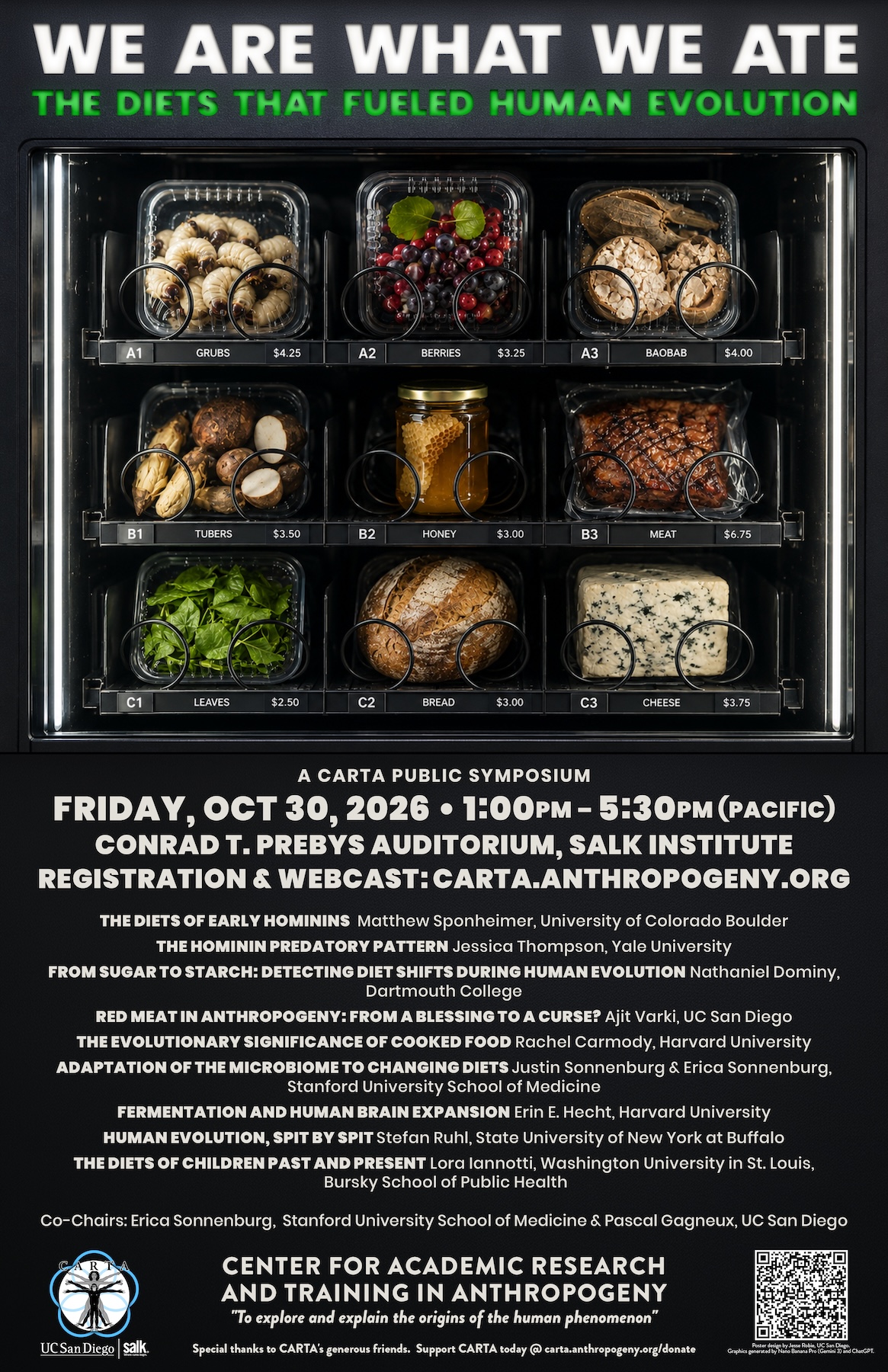
We Are What We Ate: The Diets That Fueled Human Evolution
Pascal Gagneux, UC San Diego
Erica Sonnenburg, Stanford University School of Medicine
Access to the live webcast for this symposium will be provided here on Friday, October 30 starting at 1:00 PM (Pacific Time). All talks will be recorded and posted below. Check this page or follow our social media (links in page footer) for recording updates.
The vast majority of human evolutionary history was fueled by diets composed exclusively of wild foods gathered and hunted rather than planted and raised. Compared to our ape-ancestors, and in contrast to today's living apes, members of the genus Homo have increasingly relied on technology and cumulative culture, such as use of complex tools, fire, and later fermentation, to access a broader range of foods across diverse ecosystems while defining foodways and regional identities. These innovations facilitated the global radiation of humans to every corner of the planet. Following the Last Glacial Maximum, approximately 12,000 years ago, the transition to agriculture marked a pivotal shift in human dietary patterns. The domestication of crops and livestock enabled food surplus, sedentism, and population growth, while introducing new nutritional and health consequences. More recently, widespread industrial food processing and ultra-refined diets may be driving additional physiological changes with unknown consequences for metabolism, disease, and the human microbiome, along with environmental impacts. This symposium examines the diets that fueled human evolution, drawing on evidence from paleontology, archeology, genetics, comparative anatomy and physiology, modern nutritional science, microbiome research, and ethnographic studies of the few remaining living foragers. Together, these perspectives can illuminate how dietary adaptations have shaped and continue to influence human biology, health, and culture.
| Speakers | Session |
|---|---|
 Gerald Joyce  Erica Sonnenburg |
Welcome & Opening Remarks Welcome by CARTA Co-Director and Salk Institute President, Jerry Joyce. Opening remarks by Event Co-chair, Erica Sonnenburg |
 Matthew Sponheimer |
The diets of early hominins The story of becoming human is, to a significant extent, the story of how our ancestors adapted to a changing world. Dietary transitions, linked to environmental change, have been especially important in this regard. Bipedal locomotion, tool use, and increased brain size have been offered as causes and/or consequences of hominin dietary change. Any such claims, however, are limited by the difficulty of inferring dietary behavior at millions of years’ remove. In this talk, we examine the methods... read more |
 Jessica Thompson |
The human predatory pattern Humans consume more meat than any other primate. We are also the only primate to regularly eat animals larger than ourselves. This is the human predatory pattern, but how, when, and why did this happen? What were the ecological and evolutionary circumstances that positioned our ancestors to become the first primate intruders into the carnivore guild? New fossil and archaeological discoveries dating between 4 – 2 million years ago continue to pull back the curtain on these questions, and new... read more |
 Nathaniel Dominy |
From sugar to starch: Detecting diet shifts during human evolution What did our ancestors eat? It is a challenging question because feeding behaviors seldom fossilize. How, then, do we identify the foods and dietary preferences that fueled the origin and evolution of our human lineage? Here I evaluate three complementary methods and their inferential limits. First, mechanical testing of edible plant tissues—including rainforest fruits and underground storage organs—is useful for establishing the processing (chewing) abilities of hominin teeth and jaws. Second... read more |
 Ajit Varki |
Red meat in anthropogeny: From a blessing to a curse? We humans are unusual in comparison to our primate cousins, regarding our penchant for consuming meat from large animals. Archaeological evidence of stone tools useful for butchery and cut marks on bone fossils indicate that this dietary shift predated the origin of the genus Homo about 2 million years ago. Such foods are also rich in essential amino acids, certain vitamins like B12 (not made by plants) and trace elements. Iron is essential for almost all life forms, but it is also toxic in... read more |
 Rachel Carmody |
The evolutionary significance of cooked food Cooking is a uniquely human behavior that transforms food through physical and chemical processes, making it easier to consume and digest while increasing the energy we can extract from it. Cooking may also have broadened the human dietary niche by detoxifying foods and reducing foodborne pathogens, while the control of fire may have made otherwise difficult-to-obtain foods, such as honey, more accessible. By increasing the net energetic returns and diversity of the diet, cooking and fire use... read more |
 Justin Sonnenburg Erica Sonnenburg |
Adaptation of the microbiome to changing diets The human gut houses trillions of microbes from hundreds of species forming an ecosystem called the microbiome. This ecosystem not only aids digestion and gut health, but is wired into diverse physiological processes including immune system regulation, metabolism, and central nervous system function. Unlike our human genome, our microbiome can adapt to changes in its environment on a timescale ranging from days to weeks with diet being one of the most powerful influences on the microbiome. This... read more |
 Erin Hecht |
Fermentation and human brain expansion The expansion of the human brain represents a metabolic paradox: how did our ancestors fuel such an energetically expensive organ while reducing the size of the digestive tract? While the "Cooking Hypothesis" suggests fire was the primary driver, the transition likely began much earlier. This talk will explore the External Fermentation Hypothesis, proposing that the intentional or accidental fermentation of foods could have provided a crucial "external stomach." By outsourcing the work of... read more |
 Stefan Ruhl |
Human evolution, spit by spit Saliva is needed for the pre-processing of food in the mouth, the maintenance of tooth mineralization, and protection from microbial pathogens. What is known to date about the functions of salivary proteins has largely been deduced from conventional in vitro experiments or by analogy to distantly related animal models that only incompletely represent the human condition with respect to saliva. This gap in knowledge also poses an impediment to harnessing saliva as a diagnostic fluid for dental... read more |
 Lora Iannotti |
The diets of children past and present Greater than half of the world’s children are malnourished, experiencing micronutrient deficiencies, stunted growth and development, or overweight/obesity. If malnutrition occurs during the first 1,000 days of life, there will be life-long consequences. Many populations globally no longer have access to critical elements of evolutionary dietary patterns such as animal source foods or diet diversity giving rise to these problems. We describe the empirical evidence highlighting the disconnect in... read more |
 All Speakers  Pascal Gagneux |
Wrap-up, Question & Answer Session, and Closing Remarks Question and answer session with all speakers. Wrap-Up by symposium co-chair, Erica Sonnenburg. Closing remarks by CARTA Executive Co-Director, Pascal Gagneux. |
| Attachment | Size |
|---|---|
 2026_Event_Parking_Map.pdf 2026_Event_Parking_Map.pdf | 577.01 KB |
| Abstracts_WAWWA_CARTA.pdf | 117.59 KB |
If you enjoy this event, please consider supporting CARTA's quest to explore and explain the human phenomenon.

