
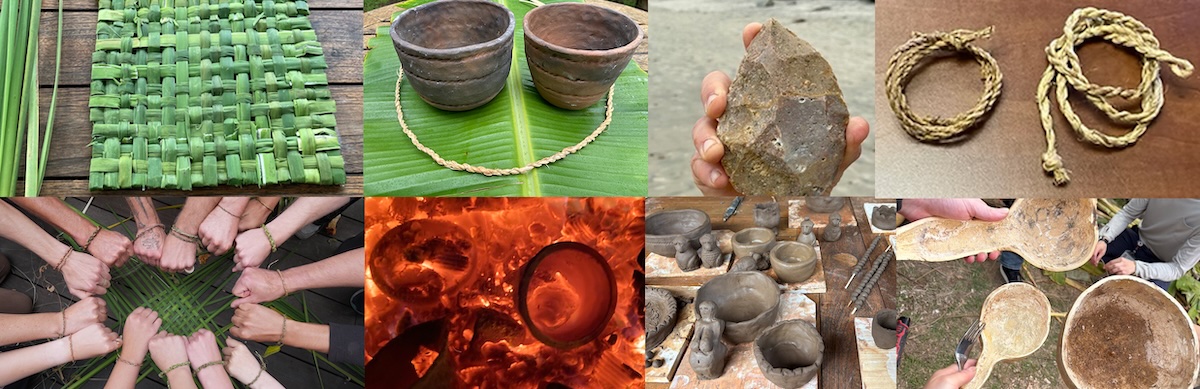
It is only very recently that human lives have been mediated by the technological amalgams of silicon, plastics, rubber, refined metals, and synthetic compounds that surround us today. The foundational human technologies that became essential for survival and defined our species emerged from natural materials and knowledge systems. They were made from stone, clay, plant, and animal materials gathered from local landscapes, sometimes transformed through the controlled use of fire, and shaped by knowledge accumulated and shared across generations.
While many of us appreciate the legacy of these technologies, the practical knowledge behind them has largely been lost. Yet for researchers seeking to understand the origins and evolution of the human phenomenon, these technologies are as important to study as DNA, fossils, or modern culture. With this perspective in mind, we developed a two-day workshop on “primordial technology” for students enrolled in the UC San Diego Graduate Specialization in Anthropogeny. In May 2026, a cohort of these students participated in this immersive experience designed to reconnect them to some of humanity’s oldest and most important technologies.
The workshop focused on three foundational technological traditions: stone, fiber, and clay.
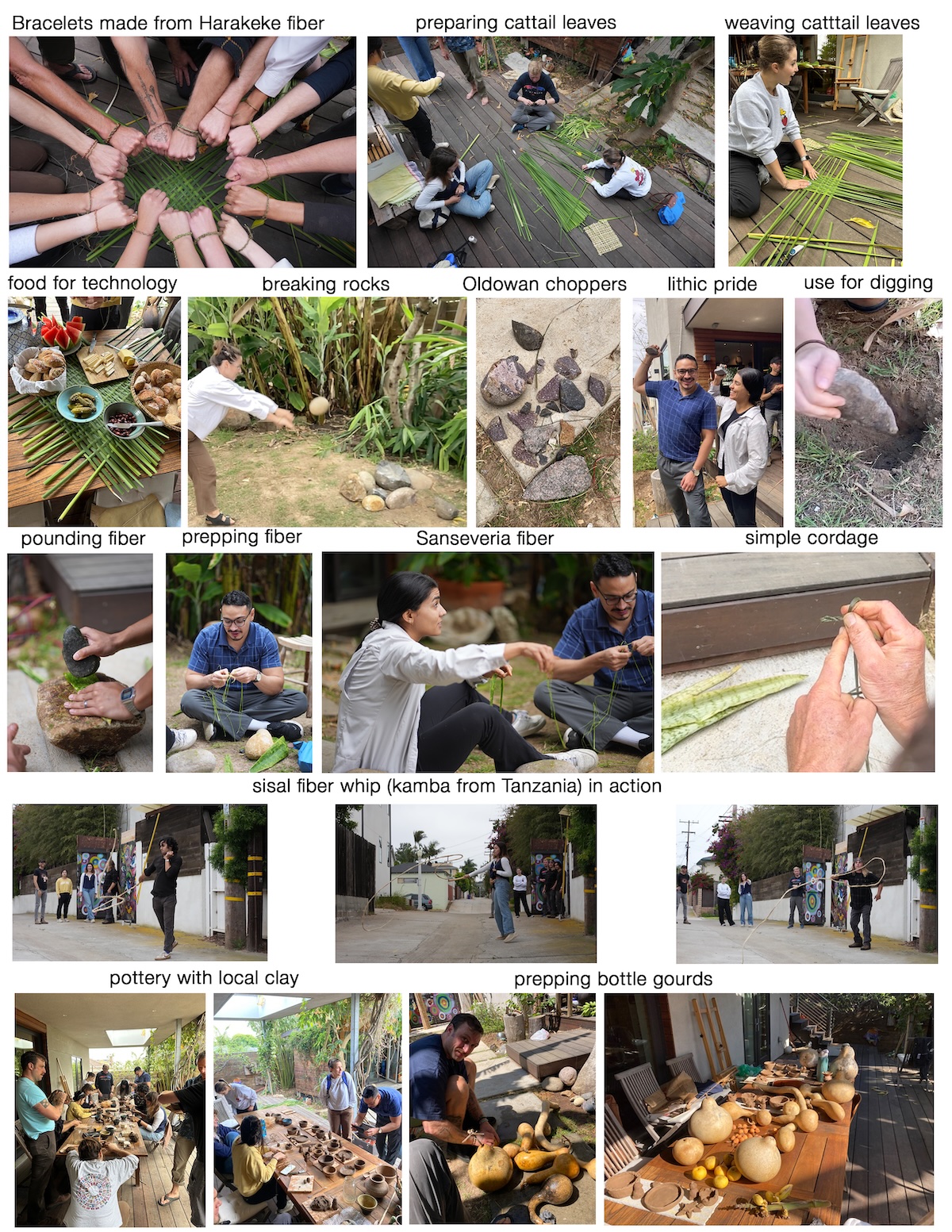
Stone tools, or lithics, represent the oldest surviving technology in the archaeological record because stone preserves exceptionally well through time. Students were introduced to several major categories of hominin stone tools, including simple hammerstones, Oldowan choppers with a single sharp edge, and Acheulean hand axes featuring two symmetrical edges. These increasingly sophisticated tools illustrate important cognitive developments, including planning, visualization, manual dexterity, and the ability to shape raw materials toward a preconceived goal.
The workshop then turned to what might be called a “string theory” of human evolution: the central role that fibers, cordage, and connective tissues have played in advanced hominin technologies. Strings are, in fact, central to life. DNA is a long molecular string that is transcribed into strings of RNA, which are then translated into strings of polypeptides. These polypeptides can combine to form giant strings of collagen in animals or they fold into three-dimensional protein building blocks and enzymes. Many of these proteins get modified by the addition of yet another type of string: polysaccharides, or sugars, such as glycosaminoglyans in animals. In plants the principal polysaccharides are also string-like, such as cellulose, the most abundant biopolymer on the planet. Insects and fungi make polysaccharides called chitin, which are strings of monosaccharides called N-Acetylglucosamine, the second most abundant biopolymer. These biopolymers are what make up the natural materials first exploited by our ancestors, such as animal bones, tendons, skin, and plant fibers.
Like stone tools, bone technology is also well represented in the paleontological record due to fossilization and petrification (the gradual replacement of organic material by inorganic minerals). In this workshop, students used antler to pressure knap the delicate edges of the Acheulean hand axes.
Plant fibers represent another critical resource as it is the best organic string for making many of the most important technologies in human evolution. However, unlike stone and bone, plant-based technology typically leaves little to no surviving evidence across deep time. Students learned to process plant fibers and transform them into cordage, producing simple bracelets and functional ropes. They worked with several species that grow readily in San Diego, including harakeke, or New Zealand flax (Phormium tenax), African Snake plant/Bowstring hemp (Sanseveria/Dracaena trifaciata), and native Yucca (Yucca filamentosa). Students also incorporated cordage and wood to form more complex and highly practical tools such as snare traps, bows, fletched arrows, bull roarers, and wood-handled whips, the latter being humanity’s first supersonic technology.
The workshop also highlighted the importance of containers, an often-overlooked technological category. Students processed bottle gourds to create vessels, using stone tools to cut openings and scrape the insides clean.
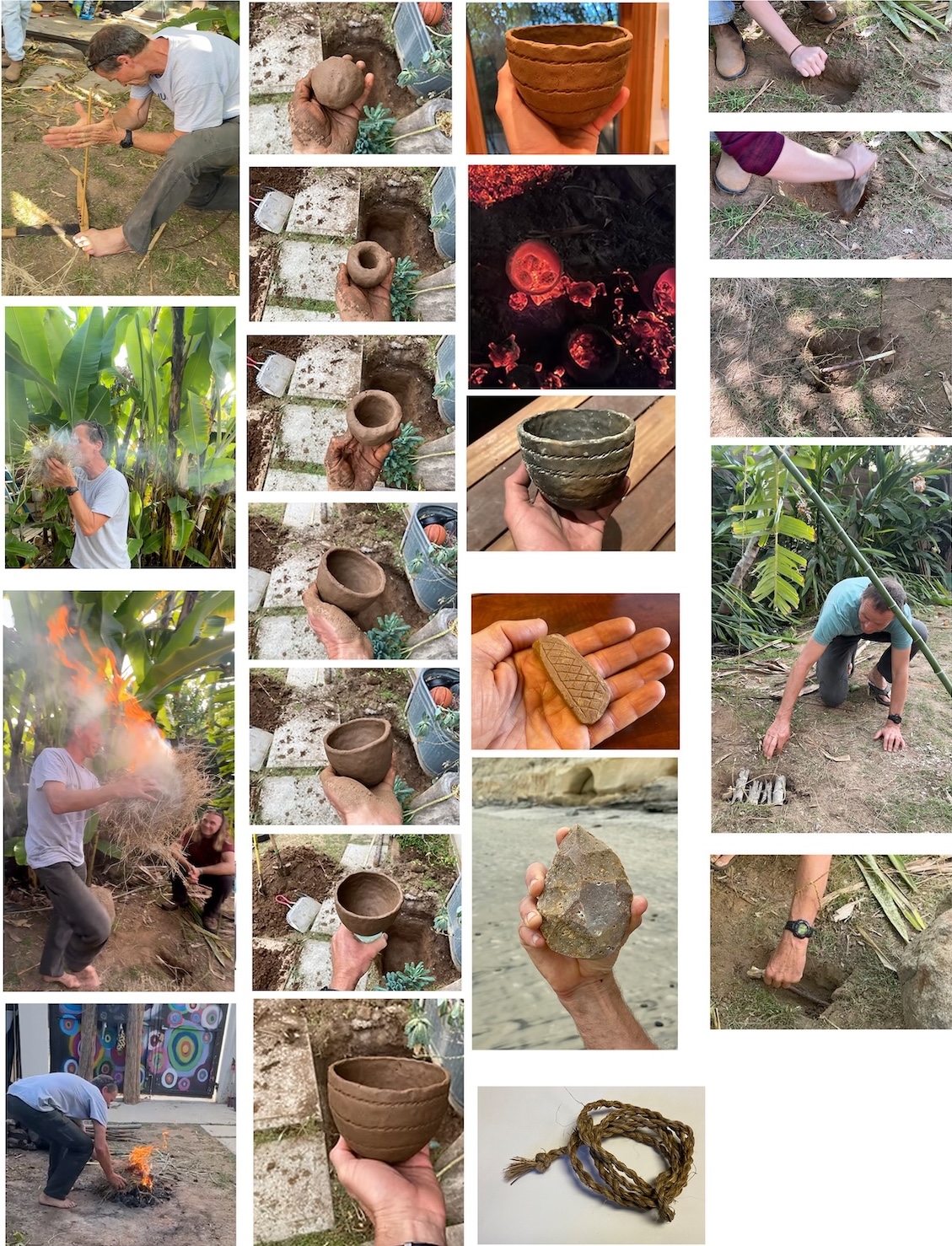
Even fire can be considered a technology of “string theory,” as one of the oldest methods of ignition relies on generating friction between two sources of cellulose, i.e. by rubbing wood sticks together. Students were shown how to make fire using the classic wooden base/hand drill technique. A dry and hollow stem of fleabane (Erigeron, a common weed) is rotated into an incense cedar base (Calocedrus decurrens, a conifer growing in the local mountains near San Diego). Alternatively, the dried stem of an inflorescence of Yucca (Adam’s Needle, Yucca filamentosa) can be used to drill into another piece of the same material. The rapid rotation creates heat and produces cedar/yucca powder, which eventually ignites into an ember that drops out of the drill hole through a pre-carved opening. Importantly, the ember has to be allowed to fully ignite, before it can be transferred into a handful of dry grass to create the first flames. Once the successful creation of fire was demonstrated, each student had an opportunity to ignite their own ember using this technique.
The final material explored was clay. Students shaped clay into figurines, beads, and simple pottery vessels and then “fired” them in the roaring campfire we created from our fire-making session. Once fired, clay becomes resistant to water and remarkably durable, effectively creating a new form of stone shaped by human hands.
None of these technologies could be made and demonstrated without another critical string: language. Language is a string of distinct sounds organized into a string of meaningful words that, when combined, can make a string of information-packed sentences. Without language, it would be extraordinarily difficult to transmit the knowledge required to make tools, teach skills, share experiences, and preserve culture across generations. In many ways, language is the technology that made all other technologies possible.
Following the workshop, the students were asked to reflect on their experiences and consider what they had learned through the process of making primordial tools. Excerpts from their reflections, along with photos from the workshop, are provided in this blog. We hope you enjoy this glimpse into the technological past of humanity. If you believe this type of interdisciplinary training is worth supporting, we encourage you to consider making a donation to CARTA so we can continue exploring and explaining the origins of the human phenomenon.
Student Refections
Carlos Escalante (Stone Tools)
Excited to make my first spearhead/proto-knife, I bashed stones against stones for hours only to achieve the suggestion of a shape, at most. However, no effort is truly futile, and the failure made me realize two things: First, I had profoundly underestimated how much effort and skill rock shaping takes (praise to Michelangelo), secondly, it made me think how important it is to choose wisely where one will pour time and effort. I can picture the birth of the Paleolithic, when the first individual discovered the advantages of cutting flesh with sharp rocks versus only using teeth and nails. I can imagine that as flesh rotted and other predators approached the fresh kill, Homo habilis had to make the most out of their feeding time. I can see a split happening, those who thought the best way to use precious calories and time was to rip the carcass apart without tools, and those who decided it was worth it to spend the energy on tool making, and the extra time — and possibly lower yield at the beginning — it took them to master Oldowan usage on every new kill.
Josh Seabough (Bottle Gourd and Fire)
By cutting off the tops and cleaning out the insides, we created bottles and bowls out of natural gourds. This process took a lot of effort, particularly for gourds whose shape made it difficult to remove all the excess pieces on the inside in order to smooth the interior. One strategy was to fill the gourd with stones and a little bit of water, then shake it repeatedly so that the rocks knocked off the excess pieces. This is a good example of how, even when producing a straightforward tool like a gourd bottle, you often need to use additional tools or techniques, demonstrating how many seemingly simple inventions depend on a broader toolkit of knowledge and skills.
Finally, the most exciting portion of the event was creating the fire that eventually was used to fire the clay pots. This process involved producing one tiny ember by rubbing together wood and reed, carefully placing the ember in dry grass collected from the neighborhood, and blowing on the grass to provide oxygen until flames were produced. This multistep process was very complex, potentially very dangerous, and something that can only have been learned through building upon generations of cultural knowledge.
Participating in this event gave me a newfound appreciation for the patience, ingenuity, and cultural knowledge required to develop these primordial tools and technologies that were once essential for everyday survival.
Skylar Batty (Biocultural Feedback)
Overall, the biggest takeaway I had from this workshop (and Stout et al., 2025) is that human tool use and technology are deeply interwoven with the evolution of human brains, bodies and social organization. In fact, human tool use and development presents a great example of biocultural feedback in human evolution. One method to examine such “techno-organic” feedback in human evolution is through the perceptual motor hypothesis (PMH). As described by Stout et al., “the core premise of the PMH is that evolving perceptual-motor capacities for technological production simultaneously support the construction of novel learning niches and the ontogenetic development of social cognitive capacities for collaboration and reproduction”. While learning to produce some of these early human technologies in this workshop, it became very clear to me the role that language, teaching and learning play in this process. Accordingly, it makes sense that the use of language may have contributed to technological development by allowing teaching, social reproduction, collaboration, abstraction and more.
As a cell biologist, I tend to think first about how genetic changes can permit phenotypic changes that are selected for based on needs present in the environment. However, this tool workshop re-emphasized to me the prevalence of gene-culture coevolution during human evolution. This concept is well demonstrated by early hominin tool use and technology where it is clear that our cultural and social behaviors surrounding tool use massively impacted our own biology by increasing brain size, communication, and learning behaviors.
Brooke Tran (Cordage and Cumulative Knowledge)
One of the most striking aspects of the workshop was learning how many technologies can emerge from materials that most modern people would overlook. Pascal biked around places in San Diego that one would pass by every day—the freeway, the sidewalk, the median—and collected plants that we then shredded into fibers using our stone tools or hands. He then showed us how to twist these various fibers into cordage, one of the most important yet archaeologically invisible technologies in human history. He explained how each plant had different properties and strengths that could be used for a variety of functions. Indeed, cordage serves as the foundation for countless technologies, including traps, nets, baskets, clothing, and shelters. Constructing rope by hand provided a tangible appreciation for the ingenuity required to develop these technologies.
Similarly, we learned to create a snare trap using the ropes we produced. This exercise illustrated how technologies are often built upon seemingly simple previous technological innovations. A trap is not simply a device; it is the culmination of knowledge about local materials, animal behavior, and mechanical principles. Throughout the workshop, this concept of how technological complexity can emerge gradually from relatively simple components was repeatedly demonstrated.
Perhaps the most memorable lesson of this workshop was learning to see objects differently. Pascal frequently examined rocks, gourds, and plants and immediately identified their potential uses. A gourd was not simply a gourd—to Pascal, it was a spoon, ladle, bowl, or vase waiting to emerge. Where others saw an ordinary stone, he recognized the potential for a hand axe, hammer, or arrowhead. This ability to envision utility highlighted an often-overlooked aspect of human technological evolution. The invention of tools requires the cognitive ability to imagine alternative futures for an object and transform it accordingly.
Shane Campbell (Shamans, Distributed Cognition, and Prosocial Behavior)
During the event itself, our Anthropogeny cohort could be compared to a small-scale community that relied on Pascal’s expertise, thus in a sense Pascal became the de facto “shaman” of this “tribe.” Many theorists who have written about shamanism have concluded that the figure of the “shaman” in any given tribe essentially boils down to a combination of intelligence plus charisma. As the students rotated between the various primitive tech stations such as whip cracking, stone knapping and plant weaving these psychometric traits were visibly employed by our “shaman” to not only instruct, but inspire the students to gain the competence required to independently work on each task. Once a learning threshold was reached, each group of students were largely able to rely on peer support to manage each station themselves. Case in point, Pascal began cutting vegetables briefly, and not long after this action was taken over and completed by several Anthropogeny students together. When taking a bird’s eye view of the entire session, the concept of “distributed cognition” pioneered by the cognitive scientist Edward Hutchins becomes apparent as the individual stations collectively contributed to the whole “primitive tech” system; which is analogous to the crew of a navy ship working together under one captain for instance.
The dinner that was shared as a result of this aforementioned preparation was thus a combination of not only the labor, and material items but also the “social” capital that was made possible by Pascal’s “shamanic” inspiration. Many social anthropologists have written about the importance of feasting as “tool” of social cohesion and bonding, furthermore the field of evolutionary psychology has demonstrated that feasting is accompanied by the release of endorphins which not only “feel good” but may stimulate pro-social behavior. Thus, collecting preparing and sharing a home-cooked meal in this regard can be conceived of as its own type of “primitive tech” enabled by our species' hyper social brains.
This was complemented by an end of the night bonfire which is perhaps the ultimate form of “primitive tech” that only our genus has been able to fully master, (likely roughly 1x10^6 years ago). This “caveman television” has an ineffable and hypnotic quality to it that likely speaks to the deepest parts of the human condition that spark imagination and creativity. In essence it is a form of “magic” that while started by the combination of friction and cellulose employed by Pascal, has a greater effect on our minds than its mere components. The fantasy author Alan Moore has stated that, “originally all of the facets of our culture whether they be in the arts, or the sciences were the province of the shaman.” Thus, using this comparison the Anthropogeny sessions held were essentially not only about learning primitive tech itself, but in a manner of speaking the accompanying “rituals” that our brains are primed to experience which enable said tech to be utilized, remembered, and amended.
Raihan Alam (Social Processes and Cultural Transmission)
When I think about tools, I often think about myself, as an individual, needing an object to fix something of mine. However, this is an extremely narrow conception of tools. As Stout and Hecht (2025) discuss, tools are part of a broader technological system that, beyond hardware and individuals, involves passed-down knowledge and social relations. Technology is a combination of material production, social collaboration, and social transmission, without which tools themselves would disappear. And because this is a social process, it is subject to the same social learning biases that shape other forms of cultural transmission. For example, people are drawn to particular models based on cues such as skill, success, and prestige. We pay attention to who others are paying attention to, especially when it is difficult to determine who is truly skilled or which skills matter most. Prestige-based learning allows effective cultural information to spread more reliably than it otherwise would. Unlike dominance, which is based on force, prestige is based on freely given respect. This was exactly what happened over the weekend. We were all helping each other craft the trap, make bracelets, and shape stones. Moreover, we did not do these things randomly; we paid attention to who was able to do this best by seeing who others were attending to and then converging on Pascal's prior knowledge and expertise. In doing so, we were engaging in prestige-based learning, observing and imitating someone we recognized as knowledgeable. In sum, the weekend made the social aspect of tools far more salient to me.
Madeline Maede (Collaboration and Division of Labor)
This quarter we had the unique opportunity to put our knowledge of early human technology to the test, going beyond lectures into the world of hands-on crafting. Over two days, we created pottery, figurines, beads, friction fire, woven mats, ropes, traps, and attempted to harness tools such as bottle gourds and whips. In addition to being a massively fun shared experience with the CARTA student cohort (led by our wise leaders Pascal and Jesse), the biggest takeaway for me was how collaborative all of these processes were. We relied on our expert teachers for instruction, our fellow students for support and advice, and the literal hands of each other to make the technologies possible.
Another excellent learning-by-doing experience was practicing using Pascal’s long, corded whip. Despite none of us using technology such as this before, it was quickly clear that some of us grasped the mechanism that could generate the miniature sonic booms more easily than others could. However, no one person was perfect at every technique we learned. While any of us could certainly learn a given skill with time and practice (Pascal & Jesse were quick to tell us of children who could keep whips of that length continually airborne and cracking), it was a fun reminder of how the division of labor in both current and early human societies enables the proliferation of different skill sets. Even in societies that make use of domesticated livestock, some individuals may never actually need to herd any animals themselves. Thus, proficient herders are valuable, but so are proficient mat weavers, and in coming together for this event all of us were able to benefit from the fruits of each other’s creations.
Patrick Bruck (Rope Making and Distribution of Ability/Interest)
Perhaps the best illustration of this came from my favorite activity: rope-making. I found it quite incredible to learn how relatively simply particular plants could be processed into fibers capable of making rope. It was neat to learn how this processing worked (and how a stone tool could be used to help), but also how different plants yielded different types of fibers, which would in turn be compatible with different types of uses. This struck me as deeply practical knowledge, and I related quite strongly to how useful it must have been for so many people across time.
I also noticed a couple interesting things about the social aspect from this activity. First, as Pascal was busy hopping around to different stations, those of us making rope continued working together, helping correct each other’s mistakes and propagate the knowledge Pascal had imparted on us. Perhaps more interestingly, we began to observe some of the group dynamics we often talk about in class, as one student, for whatever reason, took to the task in a completely natural way, and was able to absent-mindedly produce rope at a much higher rate and quality than most of the rest of us.
There was also some variation in which tasks individuals seemed most engaged with, which presumably has been a factor for groups across time. While one casually excelled in rope-making, for example, another was quite occupied cleaning and cutting his gourd – a deceptively challenging task – and others made beautiful pottery while still others seemed most content exerting themselves to turn heavy stones into just the right shape for stone tools, while still others cooked. This was quite beautiful to me, and I could imagine differences in personality and neurological makeup being fairly well-honored through these different opportunities for contribution, at least in the ideal cases.
Sam Kefer (Ceramics)
Despite a multimillion-year history of hominin tool use, ceramics did not emerge until the Upper Paleolithic era ~27-25 kya with the Venus of Dolní Věstonice (Nerudová et al., 2018). Pottery vessels appeared somewhat later in the Late Pleistocene; the earliest known shards were recovered from Xianrendong Cave in China and dated to approximately 20-19 kya, predating other East Asian fragments by more than 2,000 years (Wu et al., 2012). The advent of pottery provided a more durable alternative to hide bags, baskets, and bottle gourds and was used for storing, cooking, and consuming food (Craig et al., 2013).
Unlike our early ancestors, who practiced for many years to develop a mastery of these skills, our novice abilities would likely not have allowed us to survive the pressures of the African savannah. The complexity involved in even the simplest of tasks illustrated the level of skill, accuracy, and expertise needed to create and operate these Neolithic technologies. This workshop effectively offered a glimpse into the challenges underlying early human technological traditions.
Clara Young (Ceramics)
When our fingers were worn from twisting fiber into rope, we transitioned to learning about the first ceramics. The evidence for this technology also dates back around 20,000 years ago to small sculptures and human figurines crafted by Paleolithic hunter-gatherers in Central Europe. Like these peoples, we used naturally-occurring clay from coastal San Diego soil to craft figurines and small vessels. The process was enjoyable and forced me to ponder as to why the first known ceramic items were figurines–is it because Homo sapiens have been consistently curious about ourselves and our own bodies in some unique way? Or perhaps these items were selected for preservation by being naturally small and dense as compared to bowl-like structures that are thin and can more easily fracture when fired. The argument for the latter was strengthened in my mind when we, the following weekend, built a small fire in which to burn and harden the clay into ceramic (Figure 3). The firing process required adding our creations to a medium heat/fuel fire. The process did not appear gentle and I was shocked our items were recoverable in the following days. Overall, the step back in time to build primordial tools made me greatly respect the physicality of hunting and gathering and appreciative of the technology that allows us to live with ease as modern humans.
Meredith Rutledge (Stone Tools and Distribution of Skill/Ability)
Moving away from fibers I participated in two rock-based activities. Both were a bit of a bust for me personally, and were I to find myself living as an early human I would probably have more success contributing to the group's stores via basket and rope making. Still, I attempted to break off pieces of rock with an edge by hurling one rock at another rock. The rock I brought for this activity had been acquired / gently borrowed from the grounds of UCSD graduate housing and appeared resentful to vengeful. I only succeeded in breaking away dusty pieces of the rock at which my unyielding, bowling-ball-shaped rock was hurled.
Overall it was a great Saturday and I am sad to have missed the second one. I appreciate all of the effort that went into the necessary preparation and in showing us how to utilize these early technologies. I will definitely carry some of the skills forward, as well as the knowledge that I would certainly die alone in the woods if it really came to that. Unless, that is, I was able to find more humans to team up with, perhaps some who were horrible at making rope, but excellent at making hand axes. And I think that’s a fitting takeaway, because really what could be more human than facilitating our own survival via cooperation and knowledge sharing?

